|
| |
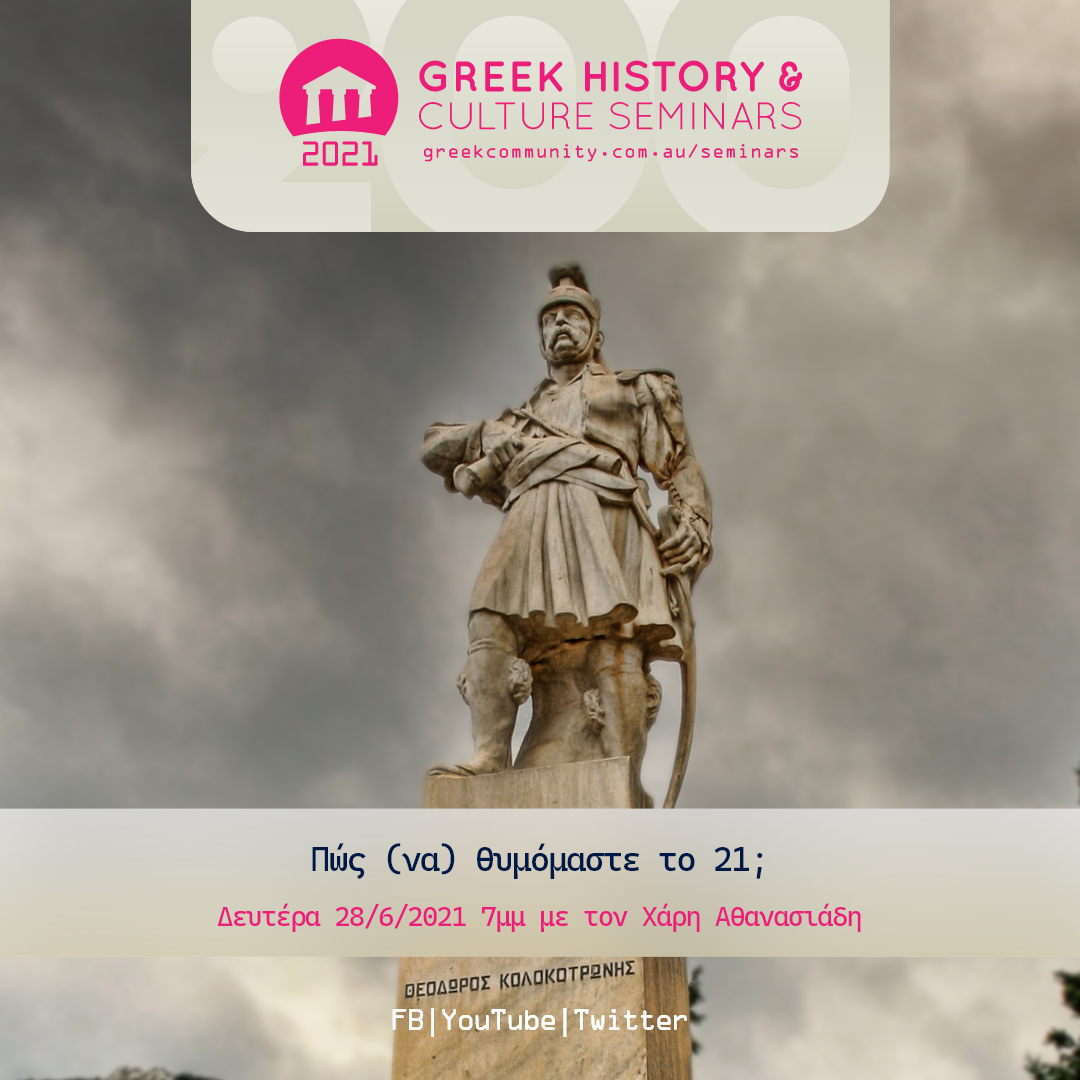
Πώς (να) θυμόμαστε το 21; How do (should) we remember 1821;
ΜΟΝΟ ΣΤΑ ΕΛΛΗΝΙΚΑ - This seminar is presented in the Greek Language
Where: YouTube Live, Facebook Live, Twitter
Date: MONDAY 28 June 2021 @ 7:00pm AEST (Melbourne) | 12:00pm EEST (Athens) | 5:00am EDT (New York)
Presenter: Prof Harris Athanasiades | Kαθηγητής Χάρης Αθανασιάδης Language of Presentation: GREEK | Knowledge of Conversational Level Greek Suggested
Entry: FREE
|
|
|
|
|
| |
Synopsis
Όσοι και όσες αναγνωρίζουμε τον εαυτό μας ως Έλληνες και Ελληνίδες γνωρίζουμε πολλά για την Επανάσταση του 1821.
Γνωρίζουμε πολλά, διότι διαβάσαμε κι ακούσαμε γι’ αυτή στο σχολείο, τον θεσμό που είναι επιφορτισμένος με την κοινωνικοποίηση των νέων μελών της εθνικής μας κοινότητας.
Όσα μάθαμε οι παλιότεροι στα μαθητικά μας χρόνια και όσα συνεχίζουν να μαθαίνουν οι σημερινοί μαθητές συγκροτούν την κυρίαρχη αφήγηση για το Εικοσιένα, την επίσημη. Πρόκειται για μια αφήγηση γνωστικά συνεκτική και συγκινησιακά φορτισμένη, η οποία όμως απέχει πλέον αρκετά από τα σύγχρονα πορίσματα της ιστορικής επιστήμης.
Πότε διαμορφώθηκε αυτή η επίσημη σχολική αφήγηση; Ποια είναι τα ουσιώδη σημεία της; Ποια από αυτά αντέχουν στη σύγχρονη ιστορική έρευνα και ποια όχι;
Και αντίστροφα: Ποια απ’ όσα λείπουν από τη σχολική ιστορία αξίζει να περιληφθούν και γιατί;
Στα ερωτήματα αυτά θα καταβληθεί προσπάθεια να δοθούν κάποιες έγκυρες απαντήσεις· απαντήσεις, δηλαδή, συμβατές τους σύγχρονους προσανατολισμούς της ιστορίας και της παιδαγωγικής.
---
Those of us who recognize ourselves as Greeks know a lot about the Revolution of 1821. We know a lot, because we have read and heard about it at school, the institution responsible for the socialization of the new younger members of our national community.
What past students learned in their student years and what today's students continue to learn constitute the dominant narrative about the 1821 Revolution, the official one. It is a narrative that is cognitively coherent and emotionally charged, but which is now far from the modern findings of historical research.
When was this official school narrative formed? What are its essential points? Which of them stand up to modern historical research and which do not? And vice versa. Which parts of the narrative is missing from school history and why?
An attempt will be made to give some valid answers to these questions.
Answers, that are compatible with the modern orientations of history and pedagogy.
|
|
|
|
|
| |
Bio
Ο Χάρης Αθανασιάδης είναι καθηγητής στο Τμήμα Φιλοσοφίας του Πανεπιστημίου Ιωαννίνων και διευθυντής του μεταπτυχιακού προγράμματος «Δημόσια Ιστορία» στο Ελληνικό Ανοικτό Πανεπιστήμιο. Οι δημοσιεύσεις, το ερευνητικό έργο και η δημόσια παρουσία του επικεντρώνονται στην Ιστορία της Εκπαίδευσης και τη Δημόσια Ιστορία. Η πιο γνωστή από τις μελέτες του τιτλοφορείται Τα αποσυρθέντα βιβλία και αποτελεί μία ανάλυση των αντιπαραθέσεων που αναπτύσσονται για τη σχολική μας Ιστορία και, συνακόλουθα, μια ανατομία των αναπαραστάσεων που κυριαρχούν στη δημόσια σφαίρα για το εθνικό μας παρελθόν (κυκλοφόρησε σε γ΄ έκδοση το 2018 από τις εκδόσεις «Αλεξάνδρεια»). --- Harris Athanasiades is a professor of History of education and Public History at the University of Ioannina (Greece). His research focuses on the social controversy concerning the relation between schooling and nation. Typical, in this respect, are his following publications in English: “Liberals, Conservatives and Romantic Nationalists in interwar education policy in Greece: The High Mountains episode”, History of Education, vol. 44, (1), 2015, pp. 64-82; “The ‘Nation-killing’ textbook. The polemic over the history textbook ‘In modern and contemporary times’ (2006-2007)”, Ricerche Storiche, vol. 44, (1), 2014, pp. 101-120. His latest book is titled: The Withdrawn Books: Nation and School-history in Greece, 1858-2008, 3rd edit: Alexandria Publications, Athens 2018 [in Greek].
|
|
|
|
|
| |
Sponsors
During the course of the year considerable expenses are incurred in staging the seminars. In order to mitigate these costs individuals or organisations are invited to donate against a lecture of their choice. You too can donate for one or more seminars and (optionally) let your name or brand be known as a patron of culture to our members, visitors and followers, as well as the broader artistic and cultural community of Melbourne. Please email: info@greekcommunity.com.au or call 03 9662 2722. We thank the following corporate sponsors:
|
|
|
|
| |
|
The Greek Community of Melbourne is registered as a charity with the Australian Charities and Non-Profits Commission ABN 14004258360
|
|
|
|
|
|